Archive for the 'Translation' Category

May 23 2013

Language Lovers 2013 – Twitter Account Category – Vote for Us !

Published by Star Translation under Translation

Vote the Top 100 Language Twitterer 2013

Click on this picture to vote for @StarTranslation

No responses yet

May 22 2013

Nominations for Language Lovers Awards 2013

Published by Star Translation under Translation

We’re nominated for Language Lovers Awards 2013 !

For the 2nd consecutive year, STAR Translation Services has been nominated for the Language Lovers Awards. We’re nominate in 2 categories, Best Language Blog and Best Language Twitter Account. We are in competition with over 100 others, we’re delighted to be in such great competition again. The awards, run by Lexiophiles, aims to reward those who love languages, and promote this, through their Social Network accounts.

To vote, it is really simple and fast: Visit the website Language Lovers 2013 and click on STAR Translation Dublin. We’ll keep you posted on progress.

Our main word is « Sharing! »

As you may already know, we are very active online with our website, our blog and also via Twitter and Facebook and Pinterest etc, which we can share and discuss with you all about languages. Our company loves giving you advice or information on languages through diverses videos or fun articles on language and authoring. Good clear examples are great ways to learn. We really appreciate your feedback and input. If you have ideas share them with us. We do try and answer all the questions we’re asked.

With expertise in over 45 languages, we are helping companies in the translation realm (websites, commercial documentation…) to increase their international business activity and, most of all, to open to the world.

So, language lovers, vote for Star TS and share your ideas!

No responses yet

May 21 2013

What is a Conlanger?

Published by Star Translation under Translation

A Conlanger is a person who creates languages (Con-Language = constructed language).

Are you familiar with “Game of Thrones” and its languages Dothraki and Valyrian?
Did you know that the language spoken by the the inhabitants of the Dothraki Sea – Dothraki, was created from scratch by David Peterson?

Peterson isn’t the only one fascinated by languages, the writer JRR Tolkien, author of “Lord of the Rings” created his own language, Elvish, even before he started to write the trilogy.

Language creation has existed for centuries and their creators are called conlangers. Paku was the first language created for “Land of the lost”, by UCLA Linguist, Victoria Fromkin. According to the Dothraki’s creator, it is a hard job and you need focus to create a sentence while maintaining the correct vocabulary and grammar. The grammar structures are one the hardest challenges to design/create.

Today, created languages are growing up as the fans are more demanding and are very careful about the translation clarity.  There are quite number of artificial languages in use today.

Trekkies will all be active Klingon speakers and STAR Wars has a variety of languages from the various planets around their universe. Other languages include Ithkuil, Irathient and Castithan both created for the Syfy chanelle drama Defiance.

As the world advances sci-fi fans are starting to embrace their languages. Some know how to speak Dothraki better than Peterson himself!

For our Irish readers here is a famous Irish proverb translated into Dothraki :

“There’s no hearth like your own hearth”

“Vo vekkhi jolini ven jolino zhorre yeri”

If you want to learn more visit :


Extracted from Source : The Irish Time – Monday, May 13, 2013

No responses yet

Apr 22 2013

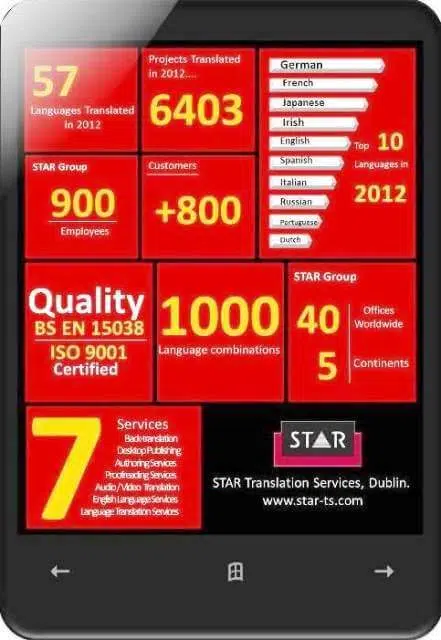
STAR by numbers

Published by Star Translation under Translation

No responses yet

Apr 16 2013

STAR by numbers

Published by Star Translation under Translation

No responses yet

Feb 12 2013

Jigger : One Word 28 Meanings

Jigger has 28 different meanings in English

When we translate we often asked clients for reference material or examples so we can understand the context of the translation, but what exactly does this mean?

OK, lets consider the following sentence:

“If the jigger seems to be broken, replace it immediately. We recommend type 2 jiggers marked in blue in our catalog.

What does that mean? Jigger is a really amazing world in English.

Jigger can be:

  1. A Handcar, a hand-operated railway car
  2. A jigger flea or chigoe flea, a parasitic arthropod found in tropical climates that may cause an inflammatory skin disease
  3. A Liverpool term for an ‘alleyway’
  4. A pallet jack
  5. A Surveyors Total Station (electronic theodolite)
  6. A tool for setting fish gill nets under ice, made of wood and metal and operated via rope from the surface
  7. In golf, an old metal golf club with a narrow face
  8. A rest for a billiard cue
  9. A miner who sorts or cleans ore by the process of jigging. One who jigs
  10. The actual sieve used in jigging ore
  11. An Irish dancer – Dancer of jigs and reels
  12. In textiles, it’s a device used in the dyeing of cloth
  13. In pottery, the horizontal lathe used in producing flatware
  14. A pendulum rolling machine for slicking or graining leather
  15. A light all-purpose tackle
  16. A small sail set in the stern of a yawl or similar boat
  17. A boat having such a sail
  18. A jigger mast
  19. A small fishing vessel, rigged like a yawl
  20. Any of a number of mechanical devices having a vibratory or jerking motion
  21. A type of hydraulic lift in which a hydraulic ram operates the lift through a block and tackle which increases the length of the stroke
  22. A device or thing the name of which is unknown or temporarily forgotten
  23. A small tackle consisting of a double and single block with a rope
  24. A small glass, esp for whisky, with a capacity of about one and a half ounces
  25. A cigarette
  26. A gadget

Verb:

  1. To alter or adjust, particularly in ways not originally intended.
  2. Rearrange or tamper with: conventional price indexes often jigger the market basket’s content

That’s 28 different meanings before we discuss slang. There are some slang terms for the word.

So the learning is that from a simple word you can have many different meanings. It’s impossible to translate the original sentence we quoted without knowing the context of what you are talking about. Next time you’re working with a translation agency or an advertising company for your products make sure you give them pictures, diagrams and background information to your project so they get the correct translation or interpretation for you first time and every time.

At STAR we specialize in technical translation and we have our own dictionary management systems for every client and industry they work in. Terminology management is the cornerstone for quality, professional translation.

No responses yet

Feb 08 2013

Calculator Spelling in Different Languages

Published by Star Translation under Translation

Did you know you can type words with your Calculator?

Something for the fun language/techies out there. It’s an old childrens game that you can make up words with your calculator. I used to spend time as a kid playing with this. So I decided to really pimp it up for 2013. Here’s the calculator alphabet and a selection of words you can try in 3 different languages.

How to write words with your calculator. Download the PDF Here: calculator_spelling

Can you think of any more?

No responses yet

Dec 19 2012

How do you write for translation?


Today we want to talk about “writing for translation”.

There are a few tips we can give to help you design better brochures, websites and software for translation.
So where should we start? One of the most important factors is

1.    Text in translation will typically expand.
For example, German typically is 40-50% longer than English.
So when you design a brochure and you have your text in place you should be aware that text will actually grow during the translation process. So to make it easier it’s actually better to design plenty of white space around your document. For example, word “cancel” in German is “abbrechen”.  6 letters versus 9. So you can see it’s a longer word which will require more space on screen. So if you have design software and you’ve got this text  “Cancel” in button, the button will have to be reisized after translation. And it can happen very often in quite a number of sentences.
That’s probably the primary thing to remember about writing for translation.

2.    Fonts can also change size as well.
So a very simple case:
A “w” is actually wider than an “i”. So in certain fonts characters are actually wider.  So what can happen is that when you design text which looks nice in your source when you translate it because you using different letters the length and layout may change.
So that means the document layout can also change so where you’ve got pictures or images you will have to move or resize them after translation.
If you can take this into consideration when you design your document or your website it will make it a lot easier to translation.

3.    Sometimes a message can actually change during translation
There is a McDonald’s example where they use the phrase “I’m lovin’ it”.
In Chinese that doesn’t really come across well because “love” is a very sensitive word in Chinese culture and it would only be said between very special people and wouldn’t be used publicly.
So they translated it into Chinese terms which literally means “I like it” so it’s a different sentence. The meaning or intent is the same but the words are different.
So to work well if you are designing a new brochure it’s always a good idea to show your translation company the draft source files before your finish  so that you can get their input on it.
They should be able to give you advice in terms of text, image or layout for your target market.

4.    Finally, be careful with abbreviations.
Abbreviations should be used very sparingly especially with technical documents. If you do use them, you should always use the full explanation of the term first and then the abbreviation. That way when someone is reading the document they know exactly what it is.

Just because you use a term every day does not mean all your customers will understand it.
For example in Ireland and UK, you have VAT tax, but in France it is TVA so it’s a different abbreviation with a different meaning.  So sometimes it’s difficult to translate terms if we don’t have the full meaning. VAT and TVA are very common but if you have specific industry terms and you use abbreviation, give your translation agency the full explanation of the terms so they can use the correct and appropriate term for you in the target language.
A little bit care of attention can make your translation better and the process a lot easier for everyone.

Thank you very much.
STAR Translation

Today we want to talk about “writing for translation”.

There are a few tips we can give to help you design better brochures, websites and software for translation.

So where should we start?

One of the most important factors is

1. that the text in translation will typically expand.

For example, German typically is 40-50% longer than English.

So when you design a brochure and you have your text in place you should be aware that text will actually grow during the translation process. So to make it easier it’s actually better to design plenty of white space around your document.

For example, word “cancel” in German is “abbrechen”. 6 letters versus 9. So you can see it’s a longer word which will require more space on screen.

So if you have design software and you’ve got this text “Cancel” in button, the button will have to be reisized after translation. And it can happen very often in quite a number of sentences.

That’s probably the primary thing to remember about writing for translation.

2. Fonts can also change size as well.

So a very simple case:

A “w” is actually wider than an “i”. So in certain fonts characters are actually wider. So what can happen is that when you design text which looks nice in your source when you translate it because you using different letters the length and layout may change.

So that means the document layout can also change so where you’ve got pictures or images you will have to move or resize them after translation.

If you can take this into consideration when you design your document or your website it will make it a lot easier to translation.

3. Sometimes a message can actually change during translation

There is a McDonald’s example where they use the phrase “I’m lovin’ it”.

In Chinese that doesn’t really come across well because “love” is a very sensitive word in Chinese culture and it would only be said between very special people and wouldn’t be used publicly.

So they translated it into Chinese terms which literally means “I like it” so it’s a different sentence. The meaning or intent is the same but the words are different.

So to work well if you are designing a new brochure its always a good idea to show your translation company the draft source files before your finish so that you can get their input on it.

They should be able to give you advice in terms of text, image or layout for your target market.

4. Finally, be careful with abbreviations.

Abbreviations should be used very sparingly especially with technical documents.

If you do use them, you should always use the full explanation of the term first and then the abbreviation. That way when someone is reading the document they know exactly what it is.

Just because you use a term every day does not mean all your customers will understand it.

For example in Ireland and UK, you have VAT tax, but in France it is TVA so it’s a different abbreviation with a different meaning. So sometimes it’s difficult to translate terms if we don’t have the full meaning. VAT and TVA are very common but if you have specific industry terms and you use abbreviation, give your translation agency the full explanation of the terms so they can use the correct and appropriate term for you in the target language.

A little bit care of attention can make your translation better and the process a lot easier for everyone.

Thank you very much.

STAR Translation

No responses yet

Dec 17 2012

Merry Christmas and Happy New Year!

Seasons Greetings Around The Globe

Joyeuses fêtes de fin d’année

Frohe Weihnachten und ein gutes Neues Jahr

Nollaig Shona Duit

Buon Natale e Felice Anno Nuovo

Feliz Navidad y Próspero Año Nuevo!

Wesołych Świąt i Szczęśliwego Nowego Roku

From all at STAR Translations Services Dublin!

If you want to see more languages, please go on http://www.star-ts.com/merrychristmas.shtml

No responses yet

Nov 27 2012

Learn how to pronounce Irish

Published by Star Translation under Gaeilge,Translation

Irish Language Synthesiser

Have you ever wished you could speak Irish or wondered how to pronounce certain words or phrases. The team in Trinity College Dublin have come up with a really novel text to speech synthesiser for the Irish Language. The site www.abair.ie enables you to simply type in the text you want spoken in Irish and it pronounces it in either the Connemara or Donegal dialect and it’s surprisingly real. We think they plan to eventually have the Munster dialect available too at some point.

To help you learn, you can enter your Irish text and change the playback speed. This way you can listen in closely to the subtle sound changes, so your Irish will improve dramatically.

You can also download a phonetic transcription of the text to learn more.

We’ve tried it out ourselves here in STAR and we think its brilliant. Thanks to Séan for finding this one for us.

Turn Written Irish Text into Speech!

No responses yet

Next »